Verses
Verse topic
Verse source

Bhagavad-Gītā 14.6,7,8
"O sinless one, the mode of goodness, being purer than the others, is illuminating, and it frees one from all sinful reactions. Those situated in that mode become conditioned by a sense of happiness and knowledge." "The mode of passion is born of unlimited desires and longings, O son of Kuntī, and because of this the embodied living entity is bound to material fruitive actions." "O son of Bharata, know that the mode of darkness, born of ignorance, is the delusion of all embodied living entities. The results of this mode are madness, indolence and sleep, which bind the conditioned soul." https://vedy.online/en/bg/14/6/ & https://vedy.online/en/bg/14/7/ & https://vedy.online/en/bg/14/8/

Bhagavad-Gītā 14.11-13
"The manifestation of the mode of goodness can be experienced when all the gates of the body are illuminated by knowledge." "O chief of the Bhāratas, when there is an increase in the mode of passion the symptoms of great attachment, fruitive activity, intense endeavor, and uncontrollable desire and hankering develop." "When there is an increase in the mode of ignorance, O son of Kuru, darkness, inertia, madness and illusion are manifested." https://vedy.online/en/bg/14/11/ & https://vedy.online/en/bg/14/12/ & https://vedy.online/en/bg/14/13/

Bhagavad-Gītā 14.14-15
"When one dies in the mode of goodness, he attains to the pure higher planets of the great sages." "When one dies in the mode of passion, he takes birth among those engaged in fruitive activities; and when one dies in the mode of ignorance, he takes birth in the animal kingdom." https://vedy.online/en/bg/14/14/ & https://vedy.online/en/bg/14/15/

Bhagavad-Gītā 14.16-17
"The result of pious action is pure and is said to be in the mode of goodness. But action done in the mode of passion results in misery, and action performed in the mode of ignorance results in foolishness." "From the mode of goodness, real knowledge develops; from the mode of passion, greed develops; and from the mode of ignorance develop foolishness, madness and illusion." https://vedy.online/en/bg/14/16/ & https://vedy.online/en/bg/14/17/

Bhagavad-Gītā 14.18
"Those situated in the mode of goodness gradually go upward to the higher planets; those in the mode of passion live on the earthly planets; and those in the abominable mode of ignorance go down to the hellish worlds." https://vedy.online/en/bg/14/18/

Bhagavad-Gītā 14.19-20
"When one properly sees that in all activities no other performer is at work than these modes of nature and he knows the Supreme Lord, who is transcendental to all these modes, he attains My spiritual nature." "When the embodied being is able to transcend these three modes associated with the material body, he can become free from birth, death, old age and their distresses and can enjoy nectar even in this life." https://vedy.online/en/bg/14/19/ & https://vedy.online/en/bg/14/20/

Bhagavad-Gītā 14.22-25
"The Supreme Personality of Godhead said: O son of Pāṇḍu, he who does not hate illumination, attachment and delusion when they are present or long for them when they disappear; who is unwavering and undisturbed through all these reactions of the material qualities, remaining neutral and transcendental, knowing that the modes alone are active; who is situated in the self and regards alike happiness and distress; who looks upon a lump of earth, a stone and a piece of gold with an equal eye; who is equal toward the desirable and the undesirable; who is steady, situated equally well in praise and blame, honor and dishonor; who treats alike both friend and enemy; and who has renounced all material activities – such a person is said to have transcended the modes of nature." Bhagavad-Gītā 14.22-25

Bhagavad-Gītā 15.1-4
"The Supreme Personality of Godhead said: It is said that there is an imperishable banyan tree that has its roots upward and its branches down and whose leaves are the Vedic hymns. One who knows this tree is the knower of the Vedas." "The branches of this tree extend downward and upward, nourished by the three modes of material nature. The twigs are the objects of the senses. This tree also has roots going down, and these are bound to the fruitive actions of human society." "The real form of this tree cannot be perceived in this world. No one can understand where it ends, where it begins, or where its foundation is. But with determination one must cut down this strongly rooted tree with the weapon of detachment. Thereafter, one must seek that place from which, having gone, one never returns, and there surrender to that Supreme Personality of Godhead from whom everything began and from whom everything has extended since time immemorial." https://vedy.online/en/bg/15/1/ & https://vedy.online/en/bg/15/2/ & 15.3-4

Bhagavad-Gītā 15.5
"Those who are free from false prestige, illusion and false association, who understand the eternal, who are done with material lust, who are freed from the dualities of happiness and distress, and who, unbewildered, know how to surrender unto the Supreme Person attain to that eternal kingdom." https://vedy.online/en/bg/15/5/

Bhagavad-Gītā 15.6
"That supreme abode of Mine is not illumined by the sun or moon, nor by fire or electricity. Those who reach it never return to this material world." https://vedy.online/en/bg/15/6/

Bhagavad-Gītā 15.7
"The living entities in this conditioned world are My eternal fragmental parts. Due to conditioned life, they are struggling very hard with the six senses, which include the mind." https://vedy.online/en/bg/15/7/
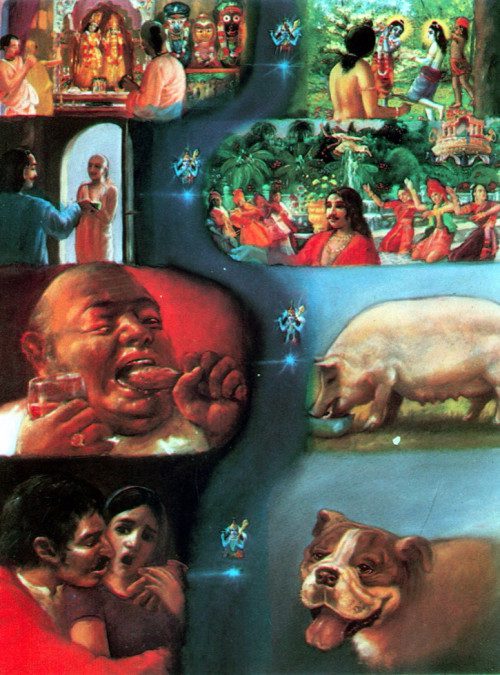
Bhagavad-Gītā 15.8-9
"The living entity in the material world carries his different conceptions of life from one body to another, as the air carries aromas. Thus he takes one kind of body and again quits it to take another." "The living entity, thus taking another gross body, obtains a certain type of ear, eye, tongue, nose and sense of touch, which are grouped about the mind. He thus enjoys a particular set of sense objects." https://vedy.online/en/bg/15/8/ & https://vedy.online/en/bg/15/9/