Verses
Verse topic
Verse source

Śrīmad-Bhāgavatam 6.1.13-14
"To concentrate the mind, one must observe a life of celibacy and not fall down. One must undergo the austerity of voluntarily giving up sense enjoyment. One must then control the mind and senses, give charity, be truthful, clean and nonviolent, follow the regulative principles and regularly chant the holy name of the Lord. Thus a sober and faithful person who knows the religious principles is temporarily purified of all sins performed with his body, words and mind. These sins are like the dried leaves of creepers beneath a bamboo tree, which may be burned by fire although their roots remain to grow again at the first opportunity." Śrīmad-Bhāgavatam 6.1.13-14

Śrīmad-Bhāgavatam 6.5.20
"[Nārada Muni had asked how one could ignorantly defy one’s own father. The Haryaśvas understood the meaning of this question.] One must accept the original instructions of the śāstra. According to Vedic civilization, one is offered a sacred thread as a sign of second birth. One takes his second birth by dint of having received instructions in the śāstra from a bona fide spiritual master. Therefore, śāstra, scripture, is the real father. All the śāstras instruct that one should end his material way of life. If one does not know the purpose of the father’s orders, the śāstras, he is ignorant. The words of a material father who endeavors to engage his son in material activities are not the real instructions of the father." https://vedy.online/en/sb6/5/20

Śrīmad-Bhāgavatam 6.10.9
"If one is unhappy to see the distress of other living beings and happy to see their happiness, his religious principles are appreciated as imperishable by exalted persons who are considered pious and benevolent." https://vedy.online/en/sb6/10/9

Śrīmad-Bhāgavatam 6.14.3-5
"In this material world there are as many living entities as atoms. Among these living entities, a very few are human beings, and among them, few are interested in following religious principles." "O best of the brāhmaṇas, Śukadeva Gosvāmī, out of many persons who follow religious principles, only a few desire liberation from the material world. Among many thousands who desire liberation, one may actually achieve liberation, giving up material attachment to society, friendship, love, country, home, wife and children. And among many thousands of such liberated persons, one who can understand the true meaning of liberation is very rare." "O great sage, among many millions who are liberated and perfect in knowledge of liberation, one may be a devotee of Lord Nārāyaṇa, or Kṛṣṇa. Such devotees, who are fully peaceful, are extremely rare." https://vedy.online/en/sb6/14/3 & https://vedy.online/en/sb6/14/4 & https://vedy.online/en/sb6/14/5
Śrīmad-Bhāgavatam 6.16.41
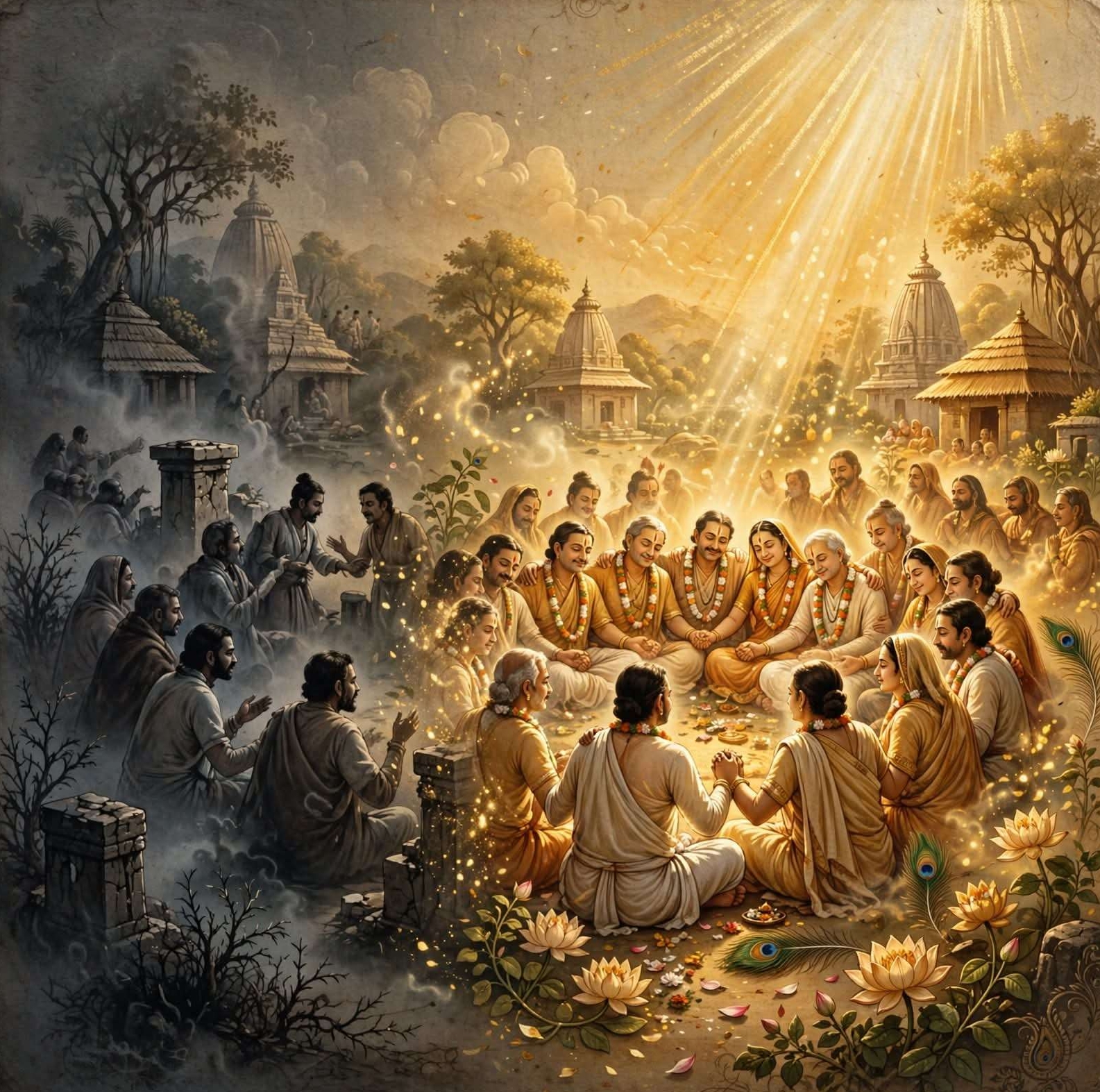
"Being full of contradictions, all forms of religion but bhāgavata-dharma work under conceptions of fruitive results and distinctions of “you and I” and “yours and mine.” The followers of Śrīmad-Bhāgavatam have no such consciousness. They are all Kṛṣṇa conscious, thinking that they are Kṛṣṇa’s and Kṛṣṇa is theirs. There are other, low-class religious systems, which are contemplated for the killing of enemies or the gain of mystic power, but such religious systems, being full of passion and envy, are impure and temporary. Because they are full of envy, they are full of irreligion." https://vedy.online/en/sb6/16/41

Śrīmad-Bhāgavatam 6.16.43
"My dear Lord, one’s occupational duty is instructed in Śrīmad-Bhāgavatam and Bhagavad-gītā according to Your point of view, which never deviates from the highest goal of life. Those who follow their occupational duties under Your supervision, being equal to all living entities, moving and nonmoving, and not considering high and low, are called Āryans. Such Āryans worship You, the Supreme Personality of Godhead." https://vedy.online/en/sb6/16/43

Śrīmad-Bhāgavatam 6.16.58
"A human being can attain perfection in life by self-realization through the Vedic literature and its practical application. This is possible especially for a human being born in India, the land of piety. A man who obtains birth in such a convenient position but does not understand his self is unable to achieve the highest perfection, even if he is exalted to life in the higher planetary systems." https://vedy.online/en/sb6/16/58

Śrīmad-Bhāgavatam 6.19.9
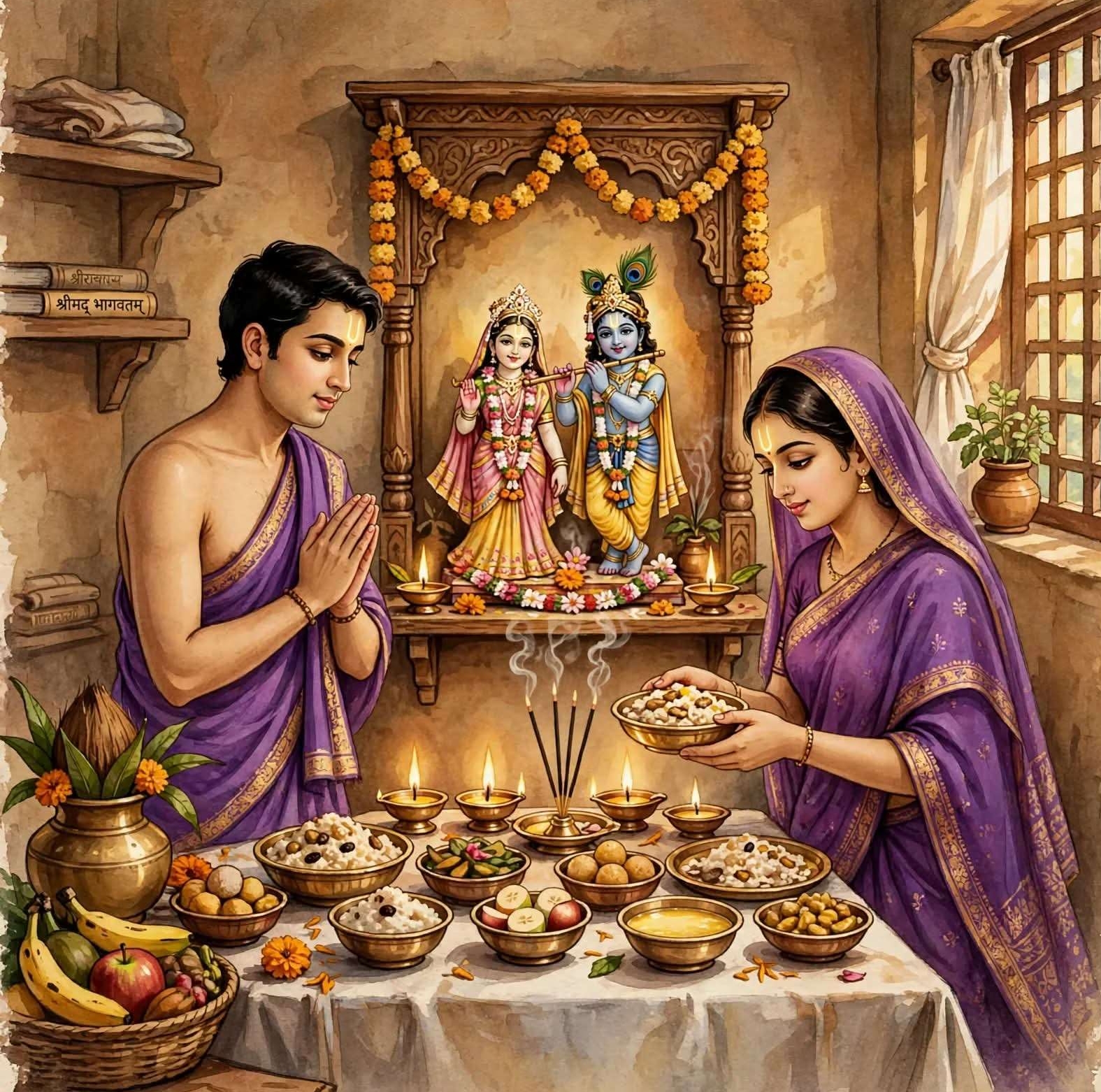
"If one desires all opulences, his duty is to daily worship Lord Viṣṇu with His wife, Lakṣmī. With great devotion one should worship Him according to the above-mentioned process. Lord Viṣṇu and the goddess of fortune are an immensely powerful combination. They are the bestowers of all benedictions and the sources of all good fortune. Therefore the duty of everyone is to worship Lakṣmī-Nārāyaṇa." https://vedy.online/en/sb6/19/9

Śrīmad-Bhāgavatam 7.11.8-12
"These are the general principles to be followed by all human beings: truthfulness, mercy, austerity (observing fasts on certain days of the month), bathing twice a day, tolerance, discrimination between right and wrong, control of the mind, control of the senses, nonviolence, celibacy, charity, reading of scripture, simplicity, satisfaction, rendering service to saintly persons, gradually taking leave of unnecessary engagements, observing the futility of the unnecessary activities of human society, remaining silent and grave and avoiding unnecessary talk, considering whether one is the body or the soul, distributing food equally to all living entities (both men and animals), seeing every soul (especially in the human form) as a part of the Supreme Lord, hearing about the activities and instructions given by the Supreme Personality of Godhead (who is the shelter of the saintly persons), chanting about these activities and instructions, always remembering these activities and instructions, trying to render service, performing worship, offering obeisances, becoming a servant, becoming a friend, and surrendering one’s whole self. O King Yudhiṣṭhira, these thirty qualifications must be acquired in the human form of life. Simply by acquiring these qualifications, one can satisfy the Supreme Personality of Godhead." Śrīmad-Bhāgavatam 7.11.8-12
Śrīmad-Bhāgavatam 7.15.9
"Because of an awakening of spiritual knowledge, those who are intelligent in regard to sacrifice, who are actually aware of religious principles and who are free from material desires, control the self in the fire of spiritual knowledge, or knowledge of the Absolute Truth. They may give up the process of ritualistic ceremonies." https://vedy.online/en/sb7/15/9

Śrīmad-Bhāgavatam 10.4.41
"The brāhmaṇas, the cows, Vedic knowledge, austerity, truthfulness, control of the mind and senses, faith, mercy, tolerance and sacrifice are the different parts of the body of Lord Viṣṇu, and they are the paraphernalia for a godly civilization." https://vedy.online/en/sb10/4/41

Śrīmad-Bhāgavatam 10.10.41
"When one is face to face with the sun, there is no longer darkness for one’s eyes. Similarly, when one is face to face with a sādhu, a devotee, who is fully determined and surrendered to the Supreme Personality of Godhead, one will no longer be subject to material bondage." https://vedy.online/en/sb10/10/41