Verses
Verse topic
Verse source

Śrīmad-Bhāgavatam 10.2.22
"A person who is very cruel is regarded as dead even while living, for while he is living or after his death, everyone condemns him. And after the death of a person in the bodily concept of life, he is undoubtedly transferred to the hell known as Andhatama." https://vedy.online/en/sb10/2/22

Śrīmad-Bhāgavatam 10.4.22
"In the bodily conception of life, one remains in darkness, without self-realization, thinking, “I am being killed” or “I have killed my enemies.” As long as a foolish person thus considers the self to be the killer or the killed, he continues to be responsible for material obligations, and consequently he suffers the reactions of happiness and distress." https://vedy.online/en/sb10/4/22

Śrīmad-Bhāgavatam 10.5.25
"Many planks and sticks, unable to stay together, are carried away by the force of a river’s waves. Similarly, although we are intimately related with friends and family members, we are unable to stay together because of our varied past deeds and the waves of time." https://vedy.online/en/sb10/5/25

Śrīmad-Bhāgavatam 10.5.30
"Every man is certainly controlled by destiny, which determines the results of one’s fruitive activities. In other words, one has a son or daughter because of unseen destiny, and when the son or daughter is no longer present, this also is due to unseen destiny. Destiny is the ultimate controller of everyone. One who knows this is never bewildered." https://vedy.online/en/sb10/5/30

Śrīmad-Bhāgavatam 10.10.10
"While living one may be proud of one’s body, thinking oneself a very big man, minister, president or even demigod, but whatever one may be, after death this body will turn either into worms, into stool or into ashes. If one kills poor animals to satisfy the temporary whims of this body, one does not know that he will suffer in his next birth, for such a sinful miscreant must go to hell and suffer the results of his actions." https://vedy.online/en/sb10/10/10

Śrīmad-Bhāgavatam 10.10.11
"While alive, does this body belong to its employer, to the self, to the father, the mother, or the mother’s father? Does it belong to the person who takes it away by force, to the slave master who purchases it, or to the sons who burn it in the fire? Or, if the body is not burned, does it belong to the dogs that eat it? Among the many possible claimants, who is the rightful claimant? Not to ascertain this but instead to maintain the body by sinful activities is not good." https://vedy.online/en/sb10/10/11

Śrīmad-Bhāgavatam 10.10.14
"By seeing their faces, one whose body has been pricked by pins can understand the pain of others who are pinpricked. Realizing that this pain is the same for everyone, he does not want others to suffer in this way. But one who has never been pricked by pins cannot understand this pain." https://vedy.online/en/sb10/10/14

Śrīmad-Bhāgavatam 10.10.15
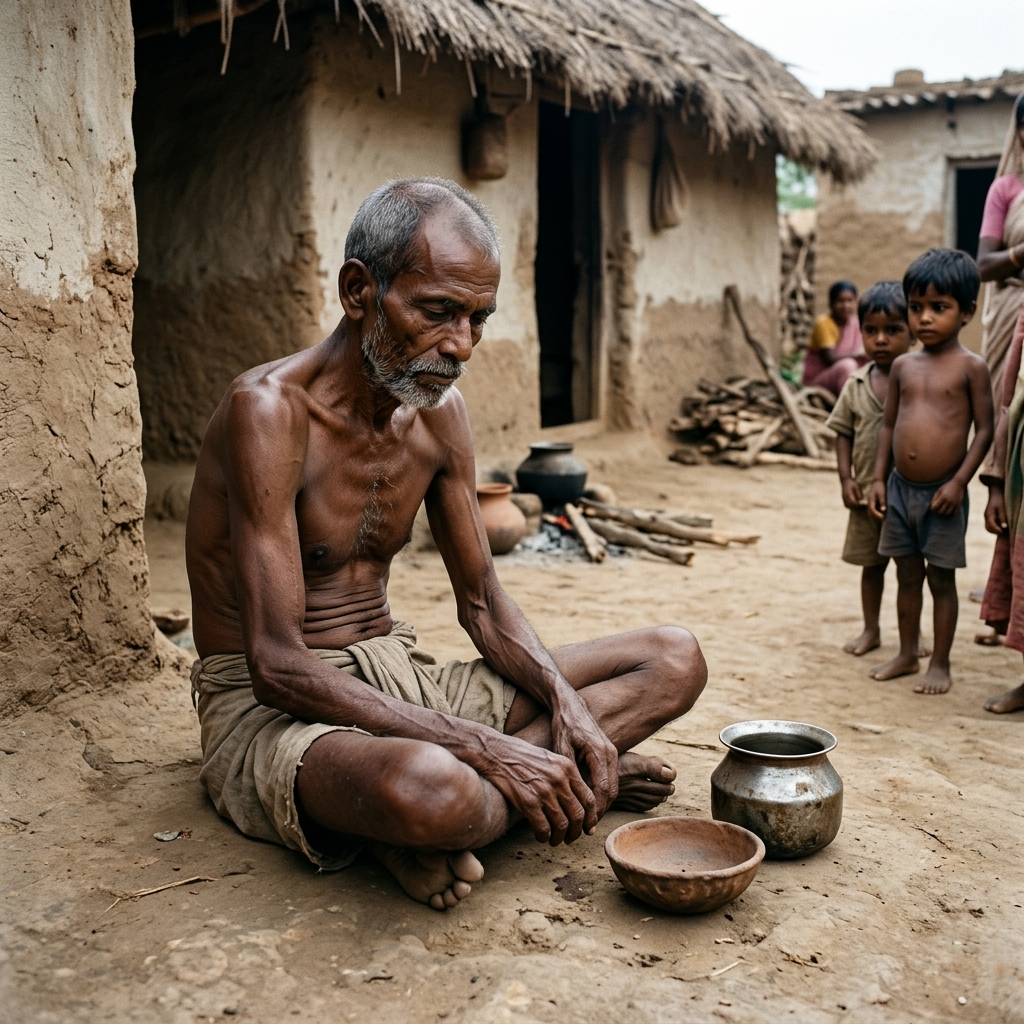
"A poverty-stricken man must automatically undergo austerities and penances because he does not have the wealth to possess anything. Thus his false prestige is vanquished. Always in need of food, shelter and clothing, he must be satisfied with what is obtained by the mercy of providence. Undergoing such compulsory austerities is good for him because this purifies him and completely frees him from false ego." https://vedy.online/en/sb10/10/15
Śrīmad-Bhāgavatam 10.10.16
"Always hungry, longing for sufficient food, a poverty-stricken man gradually becomes weaker and weaker. Having no extra potency, his senses are automatically pacified. A poverty-stricken man, therefore, is unable to perform harmful, envious activities. In other words, such a man automatically gains the results of the austerities and penances adopted voluntarily by saintly persons." https://vedy.online/en/sb10/10/16

Śrīmad-Bhāgavatam 10.10.17
"Saintly persons may freely associate with those who are poverty-stricken, but not with those who are rich. A poverty-stricken man, by association with saintly persons, very soon becomes uninterested in material desires, and the dirty things within the core of his heart are cleansed away." https://vedy.online/en/sb10/10/17

Śrīmad-Bhāgavatam 10.16.56
"The serpent Kāliya said: Our very birth as a snake has made us envious, ignorant and constantly angry. O my Lord, it is so difficult for people to give up their conditioned nature, by which they identify with that which is unreal." https://vedy.online/en/sb10/16/56

Śrīmad-Bhāgavatam 10.24.13-14
"Lord Kṛṣṇa said: It is by the force of karma that a living entity takes birth, and it is by karma alone that he meets his destruction. His happiness, distress, fear and sense of security all arise as the effects of karma." "Even if there is some supreme controller who awards all others the results of their activities, He must also depend upon a performer’s engaging in activity. After all, there is no question of being the bestower of fruitive results unless fruitive activities have actually been performed." https://vedy.online/en/sb10/24/13 & https://vedy.online/en/sb10/24/14