Verses
Verse topic
Verse source

Bhagavad-Gītā 14.22-25
"The Supreme Personality of Godhead said: O son of Pāṇḍu, he who does not hate illumination, attachment and delusion when they are present or long for them when they disappear; who is unwavering and undisturbed through all these reactions of the material qualities, remaining neutral and transcendental, knowing that the modes alone are active; who is situated in the self and regards alike happiness and distress; who looks upon a lump of earth, a stone and a piece of gold with an equal eye; who is equal toward the desirable and the undesirable; who is steady, situated equally well in praise and blame, honor and dishonor; who treats alike both friend and enemy; and who has renounced all material activities – such a person is said to have transcended the modes of nature." Bhagavad-Gītā 14.22-25

Bhagavad-Gītā 15.1-4
"The Supreme Personality of Godhead said: It is said that there is an imperishable banyan tree that has its roots upward and its branches down and whose leaves are the Vedic hymns. One who knows this tree is the knower of the Vedas." "The branches of this tree extend downward and upward, nourished by the three modes of material nature. The twigs are the objects of the senses. This tree also has roots going down, and these are bound to the fruitive actions of human society." "The real form of this tree cannot be perceived in this world. No one can understand where it ends, where it begins, or where its foundation is. But with determination one must cut down this strongly rooted tree with the weapon of detachment. Thereafter, one must seek that place from which, having gone, one never returns, and there surrender to that Supreme Personality of Godhead from whom everything began and from whom everything has extended since time immemorial." https://vedy.online/en/bg/15/1/ & https://vedy.online/en/bg/15/2/ & 15.3-4
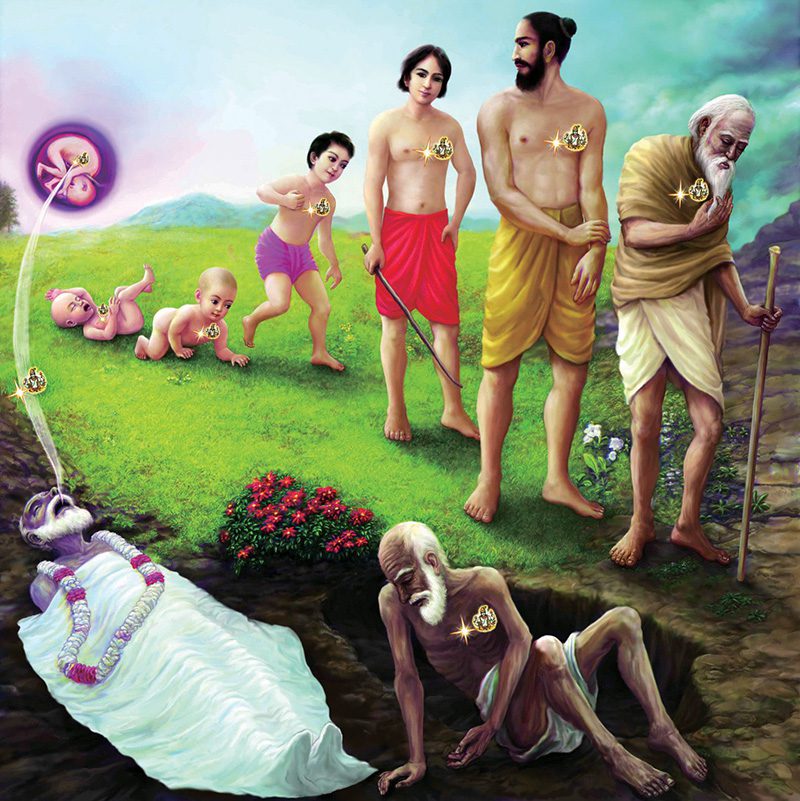
Bhagavad-Gītā 15.10-11
"The foolish cannot understand how a living entity can quit his body, nor can they understand what sort of body he enjoys under the spell of the modes of nature. But one whose eyes are trained in knowledge can see all this." "The endeavoring transcendentalists who are situated in self-realization can see all this clearly. But those whose minds are not developed and who are not situated in self-realization cannot see what is taking place, though they may try." https://vedy.online/en/bg/15/10/ & https://vedy.online/en/bg/15/11/

Bhagavad-Gītā 17.2-4
"The Supreme Personality of Godhead said: According to the modes of nature acquired by the embodied soul, one’s faith can be of three kinds – in goodness, in passion or in ignorance. Now hear about this." "O son of Bharata, according to one’s existence under the various modes of nature, one evolves a particular kind of faith. The living being is said to be of a particular faith according to the modes he has acquired." "Men in the mode of goodness worship the demigods; those in the mode of passion worship the demons; and those in the mode of ignorance worship ghosts and spirits." https://vedy.online/en/bg/17/2/ & https://vedy.online/en/bg/17/3/ & https://vedy.online/en/bg/17/4/

Bhagavad-Gītā 17.7-10
"Even the food each person prefers is of three kinds, according to the three modes of material nature. The same is true of sacrifices, austerities and charity. Now hear of the distinctions between them." "Foods dear to those in the mode of goodness increase the duration of life, purify one’s existence and give strength, health, happiness and satisfaction. Such foods are juicy, fatty, wholesome, and pleasing to the heart." "Foods that are too bitter, too sour, salty, hot, pungent, dry and burning are dear to those in the mode of passion. Such foods cause distress, misery and disease." "Food prepared more than three hours before being eaten, food that is tasteless, decomposed and putrid, and food consisting of remnants and untouchable things is dear to those in the mode of darkness." https://vedy.online/en/bg/17/7/ & https://vedy.online/en/bg/17/8/ & https://vedy.online/en/bg/17/9/ & https://vedy.online/en/bg/17/10/

Bhagavad-Gītā 17.11-13
"Of sacrifices, the sacrifice performed according to the directions of scripture, as a matter of duty, by those who desire no reward, is of the nature of goodness." "But the sacrifice performed for some material benefit, or for the sake of pride, O chief of the Bhāratas, you should know to be in the mode of passion." "Any sacrifice performed without regard for the directions of scripture, without distribution of prasādam [spiritual food], without chanting of Vedic hymns and remunerations to the priests, and without faith is considered to be in the mode of ignorance." https://vedy.online/en/bg/17/11/ & https://vedy.online/en/bg/17/12/ & https://vedy.online/en/bg/17/13/

Bhagavad-Gītā 17.17-19
"This threefold austerity, performed with transcendental faith by men not expecting material benefits but engaged only for the sake of the Supreme, is called austerity in goodness." "Penance performed out of pride and for the sake of gaining respect, honor and worship is said to be in the mode of passion. It is neither stable nor permanent." "Penance performed out of foolishness, with self-torture or to destroy or injure others, is said to be in the mode of ignorance." https://vedy.online/en/bg/17/17/ & https://vedy.online/en/bg/17/18/ & https://vedy.online/en/bg/17/19/

Bhagavad-Gītā 17.20-22
"Charity given out of duty, without expectation of return, at the proper time and place, and to a worthy person is considered to be in the mode of goodness." "But charity performed with the expectation of some return, or with a desire for fruitive results, or in a grudging mood is said to be charity in the mode of passion." "And charity performed at an impure place, at an improper time, to unworthy persons, or without proper attention and respect is said to be in the mode of ignorance." https://vedy.online/en/bg/17/20/ & https://vedy.online/en/bg/17/21/ & https://vedy.online/en/bg/17/22/

Bhagavad-Gītā 18.10-11
"The intelligent renouncer situated in the mode of goodness, neither hateful of inauspicious work nor attached to auspicious work, has no doubts about work." "It is indeed impossible for an embodied being to give up all activities. But he who renounces the fruits of action is called one who has truly renounced." https://vedy.online/en/bg/18/10/ & https://vedy.online/en/bg/18/11/

Bhagavad-Gītā 18.19-22
"According to the three different modes of material nature, there are three kinds of knowledge, action and performer of action. Now hear of them from Me." "That knowledge by which one undivided spiritual nature is seen in all living entities, though they are divided into innumerable forms, you should understand to be in the mode of goodness." "That knowledge by which one sees that in every different body there is a different type of living entity you should understand to be in the mode of passion." "And that knowledge by which one is attached to one kind of work as the all in all, without knowledge of the truth, and which is very meager, is said to be in the mode of darkness." https://vedy.online/en/bg/18/19/ & https://vedy.online/en/bg/18/20/ & https://vedy.online/en/bg/18/21/ & https://vedy.online/en/bg/18/22/

Bhagavad-Gītā 18.23-25
"That action which is regulated and which is performed without attachment, without love or hatred, and without desire for fruitive results is said to be in the mode of goodness." "But action performed with great effort by one seeking to gratify his desires, and enacted from a sense of false ego, is called action in the mode of passion." "That action performed in illusion, in disregard of scriptural injunctions, and without concern for future bondage or for violence or distress caused to others is said to be in the mode of ignorance." https://vedy.online/en/bg/18/23/ & https://vedy.online/en/bg/18/24/ & https://vedy.online/en/bg/18/25/

Bhagavad-Gītā 18.26-28
"One who performs his duty without association with the modes of material nature, without false ego, with great determination and enthusiasm, and without wavering in success or failure is said to be a worker in the mode of goodness." "The worker who is attached to work and the fruits of work, desiring to enjoy those fruits, and who is greedy, always envious, impure, and moved by joy and sorrow, is said to be in the mode of passion." "The worker who is always engaged in work against the injunctions of the scripture, who is materialistic, obstinate, cheating and expert in insulting others, and who is lazy, always morose and procrastinating is said to be a worker in the mode of ignorance." https://vedy.online/en/bg/18/26/ & https://vedy.online/en/bg/18/27/ & https://vedy.online/en/bg/18/28/