Verses
Verse topic
Verse source

Bhagavad-Gītā 6.19
"As a lamp in a windless place does not waver, so the transcendentalist, whose mind is controlled, remains always steady in his meditation on the transcendent Self." https://vedy.online/en/bg/6/19/
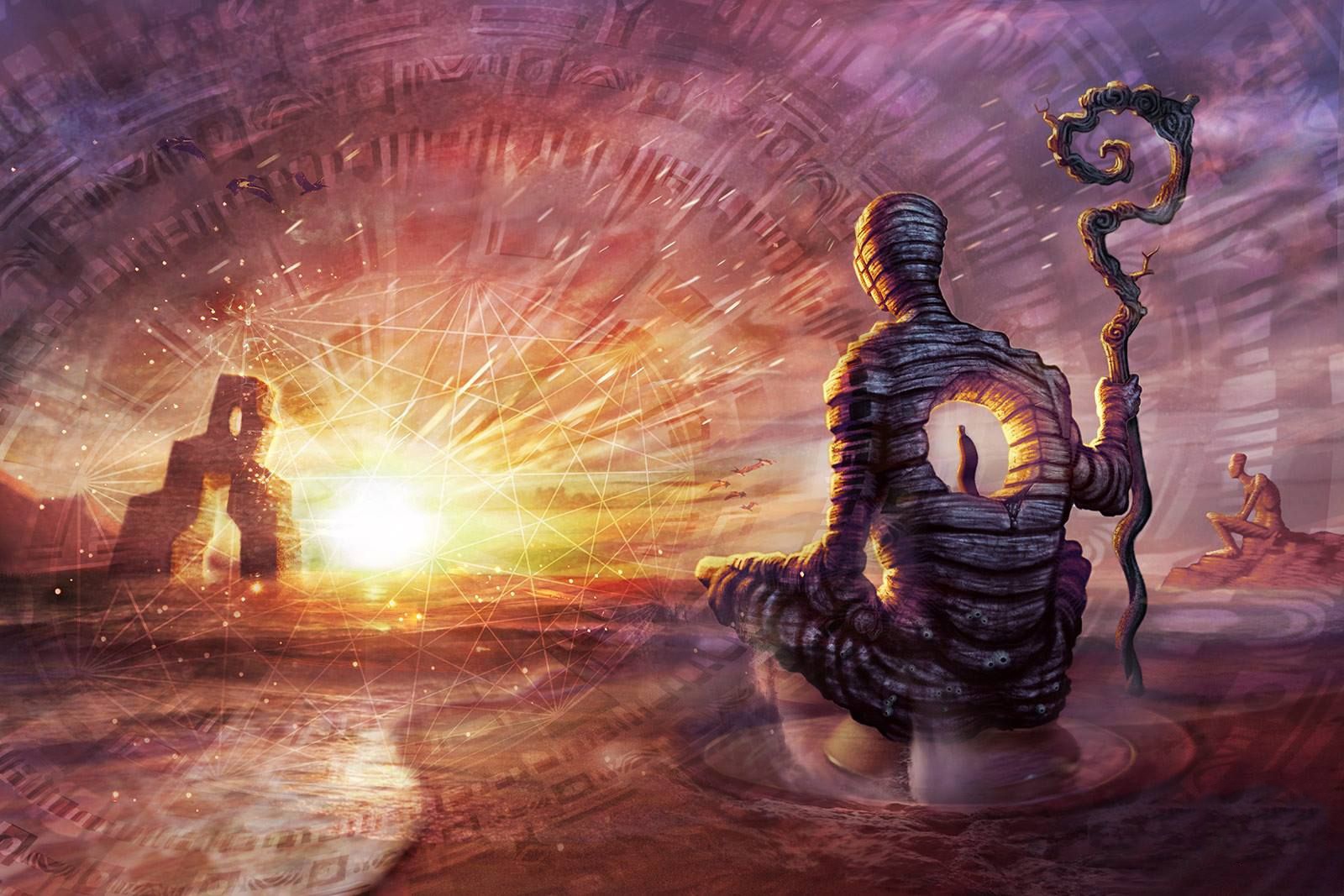
Bhagavad-Gītā 6.20-23
"In the stage of perfection called trance, or samādhi, one’s mind is completely restrained from material mental activities by practice of yoga. This perfection is characterized by one’s ability to see the Self by the pure mind and to relish and rejoice in the Self. In that joyous state, one is situated in boundless transcendental happiness, realized through transcendental senses. Established thus, one never departs from the truth, and upon gaining this he thinks there is no greater gain. Being situated in such a position, one is never shaken, even in the midst of greatest difficulty. This indeed is actual freedom from all miseries arising from material contact." Bhagavad-Gītā 6.20-23

Bhagavad-Gītā 6.24-26
"One should engage oneself in the practice of yoga with determination and faith and not be deviated from the path. One should abandon, without exception, all material desires born of mental speculation and thus control all the senses on all sides by the mind." "Gradually, step by step, one should become situated in trance by means of intelligence sustained by full conviction, and thus the mind should be fixed on the Self alone and should think of nothing else." "From wherever the mind wanders due to its flickering and unsteady nature, one must certainly withdraw it and bring it back under the control of the Self." https://vedy.online/en/bg/6/24/ & https://vedy.online/en/bg/6/25/ & https://vedy.online/en/bg/6/26/

Bhagavad-Gītā 6.33-34
"Arjuna said: O Madhusūdana, the system of yoga which You have summarized appears impractical and unendurable to me, for the mind is restless and unsteady." "The mind is restless, turbulent, obstinate and very strong, O Kṛṣṇa, and to subdue it, I think, is more difficult than controlling the wind." https://vedy.online/en/bg/6/33/ & https://vedy.online/en/bg/6/34/

Bhagavad-Gītā 6.35
"Lord Śrī Kṛṣṇa said: O mighty-armed son of Kuntī, it is undoubtedly very difficult to curb the restless mind, but it is possible by suitable practice and by detachment." https://vedy.online/en/bg/6/35/

Bhagavad-Gītā 6.36
"For one whose mind is unbridled, self-realization is difficult work. But he whose mind is controlled and who strives by appropriate means is assured of success. That is My opinion." https://vedy.online/en/bg/6/36/

Bhagavad-Gītā 8.5 & 8.7
"And whoever, at the end of his life, quits his body remembering Me alone at once attains My nature. Of this there is no doubt." "Therefore, Arjuna, you should always think of Me in the form of Kṛṣṇa and at the same time carry out your prescribed duty of fighting. With your activities dedicated to Me and your mind and intelligence fixed on Me, you will attain Me without doubt." https://vedy.online/en/bg/8/5/ & https://vedy.online/en/bg/8/7/

Bhagavad-Gītā 8.8
"He who meditates on Me as the Supreme Personality of Godhead, his mind constantly engaged in remembering Me, undeviated from the path, he, O Pārtha, is sure to reach Me." https://vedy.online/en/bg/8/8/

Bhagavad-Gītā 8.10
"One who, at the time of death, fixes his life air between the eyebrows and, by the strength of yoga, with an undeviating mind, engages himself in remembering the Supreme Lord in full devotion, will certainly attain to the Supreme Personality of Godhead." https://vedy.online/en/bg/8/10/

Bhagavad-Gītā 17.14-16
"Austerity of the body consists in worship of the Supreme Lord, the brāhmaṇas, the spiritual master, and superiors like the father and mother, and in cleanliness, simplicity, celibacy and nonviolence." "Austerity of speech consists in speaking words that are truthful, pleasing, beneficial, and not agitating to others, and also in regularly reciting Vedic literature." "And satisfaction, simplicity, gravity, self-control and purification of one’s existence are the austerities of the mind." https://vedy.online/en/bg/17/14/ & https://vedy.online/en/bg/17/15/ & https://vedy.online/en/bg/17/16/

Bhagavad-Gītā 18.2
"The Supreme Personality of Godhead said: The giving up of activities that are based on material desire is what great learned men call the renounced order of life [sannyāsa]. And giving up the results of all activities is what the wise call renunciation [tyāga]." https://vedy.online/en/bg/18/2/

Bhagavad-Gītā 18.51-53
"Being purified by his intelligence and controlling the mind with determination, giving up the objects of sense gratification, being freed from attachment and hatred, one who lives in a secluded place, who eats little, who controls his body, mind and power of speech, who is always in trance and who is detached, free from false ego, false strength, false pride, lust, anger, and acceptance of material things, free from false proprietorship, and peaceful – such a person is certainly elevated to the position of self-realization." Bhagavad-Gītā 18.51-53