Verses
Verse topic
Verse source

Śrīmad-Bhāgavatam 11.2.36
"In accordance with the particular nature one has acquired in conditioned life, whatever one does with body, words, mind, senses, intelligence or purified consciousness one should offer to the Supreme, thinking, “This is for the pleasure of Lord Nārāyaṇa.”" https://vedy.online/en/sb11/2/36

Śrīmad-Bhāgavatam 11.2.37
"Fear arises when a living entity misidentifies himself as the material body because of absorption in the external, illusory energy of the Lord. When the living entity thus turns away from the Supreme Lord, he also forgets his own constitutional position as a servant of the Lord. This bewildering, fearful condition is effected by the potency for illusion, called māyā. Therefore, an intelligent person should engage unflinchingly in the unalloyed devotional service of the Lord, under the guidance of a bona fide spiritual master, whom he should accept as his worshipable deity and as his very life and soul." https://vedy.online/en/sb11/2/37

Śrīmad-Bhāgavatam 11.2.38
"Although the duality of the material world does not ultimately exist, the conditioned soul experiences it as real under the influence of his own conditioned intelligence. This imaginary experience of a world separate from Kṛṣṇa can be compared to the acts of dreaming and desiring. When the conditioned soul dreams at night of something desirable or horrible, or when he daydreams of what he would like to have or avoid, he creates a reality that has no existence beyond his own imagination. The tendency of the mind is to accept and reject various activities based on sense gratification. Therefore an intelligent person should control the mind, restricting it from the illusion of seeing things separate from Kṛṣṇa, and when the mind is thus controlled he will experience actual fearlessness." https://vedy.online/en/sb11/2/38
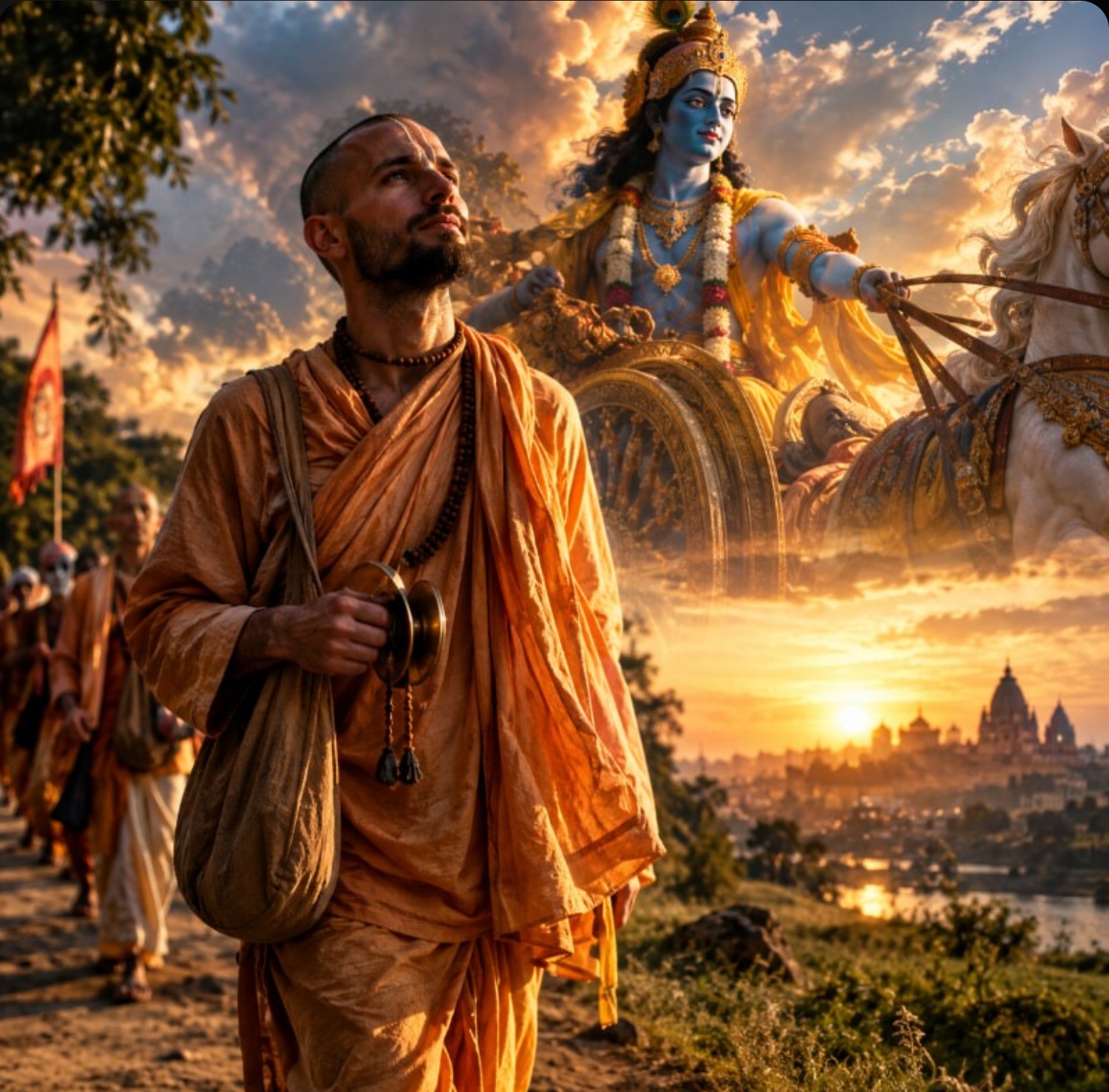
Śrīmad-Bhāgavatam 11.2.39
"An intelligent person who has controlled his mind and conquered fear should give up all attachment to material objects such as wife, family and nation and should wander freely without embarrassment, hearing and chanting the holy names of the Lord, the bearer of the chariot wheel. The holy names of Kṛṣṇa are all-auspicious because they describe His transcendental birth and activities, which He performs within this world for the salvation of the conditioned souls. Thus the holy names of the Lord are sung throughout the world." https://vedy.online/en/sb11/2/39

Śrīmad-Bhāgavatam 11.2.40
"By chanting the holy name of the Supreme Lord, one comes to the stage of love of Godhead. Then the devotee is fixed in his vow as an eternal servant of the Lord, and he gradually becomes very much attached to a particular name and form of the Supreme Personality of Godhead. As his heart melts with ecstatic love, he laughs very loudly or cries or shouts. Sometimes he sings and dances like a madman, for he is indifferent to public opinion." https://vedy.online/en/sb11/2/40

Śrīmad-Bhāgavatam 11.2.42
"Devotion, direct experience of the Supreme Lord, and detachment from other things — these three occur simultaneously for one who has taken shelter of the Supreme Personality of Godhead, in the same way that pleasure, nourishment and relief from hunger come simultaneously and increasingly, with each bite, for a person engaged in eating." https://vedy.online/en/sb11/2/42

Śrīmad-Bhāgavatam 11.2.43
"My dear King, the devotee who worships the lotus feet of the infallible Personality of Godhead with constant endeavor thus achieves unflinching devotion, detachment and experienced knowledge of the Personality of Godhead. In this way the successful devotee of the Lord achieves supreme spiritual peace." https://vedy.online/en/sb11/2/43

Śrīmad-Bhāgavatam 11.2.47
"A devotee who faithfully engages in the worship of the Deity in the temple but does not behave properly toward other devotees or people in general is called a prākṛta-bhakta, a materialistic devotee, and is considered to be in the lowest position." https://vedy.online/en/sb11/2/47
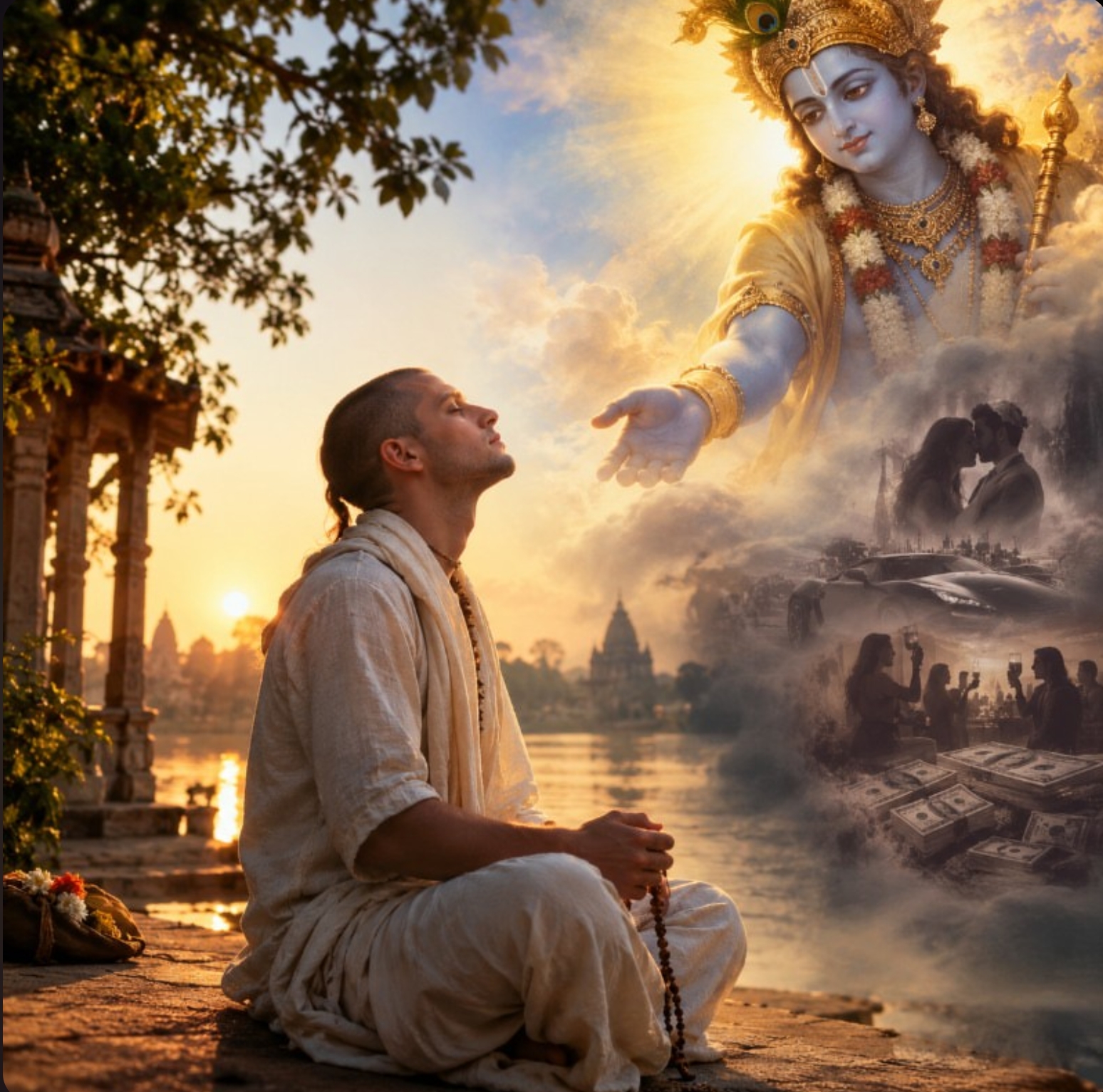
Śrīmad-Bhāgavatam 11.2.50
"One who has taken exclusive shelter of the Supreme Lord, Vāsudeva, becomes free from fruitive activities, which are based on material lust. In fact, one who has taken shelter of the lotus feet of the Lord is freed from even the desire to enjoy material sense gratification. Plans for enjoying sex life, social prestige and money cannot develop within his mind. Thus he is considered bhāgavatottama, a pure devotee of the Lord on the highest platform." https://vedy.online/en/sb11/2/50

Śrīmad-Bhāgavatam 11.2.51
"Birth in an aristocratic family and the execution of austere and pious activities certainly cause one to take pride in himself. Similarly, if one enjoys a prestigious position within society because his parents are highly respected members of the varṇāśrama social system, one becomes even more infatuated with himself. But if despite these excellent material qualifications one does not feel even a tinge of pride within himself, he is to be considered the dearmost servitor of the Supreme Personality of Godhead." https://vedy.online/en/sb11/2/51

Śrīmad-Bhāgavatam 11.2.52
"When a devotee gives up the selfish conception by which one thinks “This is my property, and that is his,” and when he is no longer concerned with the pleasures of his own material body or indifferent to the discomforts of others, he becomes fully peaceful and satisfied. He considers himself simply one among all the living beings who are equally part and parcel of the Supreme Personality of Godhead. Such a satisfied Vaiṣṇava is considered to be at the highest standard of devotional service." https://vedy.online/en/sb11/2/52

Śrīmad-Bhāgavatam 11.2.53
"The lotus feet of the Supreme Personality of Godhead are sought even by the greatest of demigods, such as Brahmā and Śiva, who have all accepted the Supreme Personality of Godhead as their life and soul. A pure devotee of the Lord can never forget those lotus feet in any circumstance. He will not give up his shelter at the lotus feet of the Lord for a single moment — indeed, not for half a moment — even in exchange for the benediction of ruling and enjoying the opulence of the entire universe. Such a devotee of the Lord is to be considered the best of the Vaiṣṇavas." https://vedy.online/en/sb11/2/53