Verses
Verse topic
Verse source

Śrīmad-Bhāgavatam 7.2.48
"It is fruitless to see and talk of the material modes of nature and their resultant so-called happiness and distress as if they were factual. When the mind wanders during the day and a man begins to think himself extremely important, or when he dreams at night and sees a beautiful woman enjoying with him, these are merely false dreams. Similarly, the happiness and distress caused by the material senses should be understood to be meaningless." https://vedy.online/en/sb7/2/48

Śrīmad-Bhāgavatam 7.2.49
"Those who have full knowledge of self-realization, who know very well that the spirit soul is eternal whereas the body is perishable, are not overwhelmed by lamentation. But persons who lack knowledge of self-realization certainly lament. Therefore it is difficult to educate a person in illusion." https://vedy.online/en/sb7/2/49

Śrīmad-Bhāgavatam 7.2.60
"Therefore none of you should be aggrieved for the loss of the body — whether your own or those of others. Only in ignorance does one make bodily distinctions, thinking “Who am I? Who are the others? What is mine? What is for others?”" https://vedy.online/en/sb7/2/60

Śrīmad-Bhāgavatam 7.4.31
"[The qualities of Mahārāja Prahlāda, the son of Hiraṇyakaśipu, are described herewith.] He was completely cultured as a qualified brāhmaṇa, having very good character and being determined to understand the Absolute Truth. He had full control of his senses and mind. Like the Supersoul, he was kind to every living entity and was the best friend of everyone. To respectable persons he acted exactly like a menial servant, to the poor he was like a father, to his equals he was attached like a sympathetic brother, and he considered his teachers, spiritual masters and older Godbrothers to be as good as the Supreme Personality of Godhead. He was completely free from unnatural pride that might have arisen from his good education, riches, beauty, aristocracy and so on." Śrīmad-Bhāgavatam 7.4.31-32

Śrīmad-Bhāgavatam 7.4.34
"O King, Prahlāda Mahārāja’s good qualities are still glorified by learned saints and Vaiṣṇavas. As all good qualities are always found existing in the Supreme Personality of Godhead, they also exist forever in His devotee Prahlāda Mahārāja." https://vedy.online/en/sb7/4/34

Śrīmad-Bhāgavatam 7.5.12
"When the Supreme Personality of Godhead is pleased with the living entity because of his devotional service, one becomes a paṇḍita and does not make distinctions between enemies, friends and himself. Intelligently, he then thinks, “Every one of us is an eternal servant of God, and therefore we are not different from one another.”" https://vedy.online/en/sb7/5/12
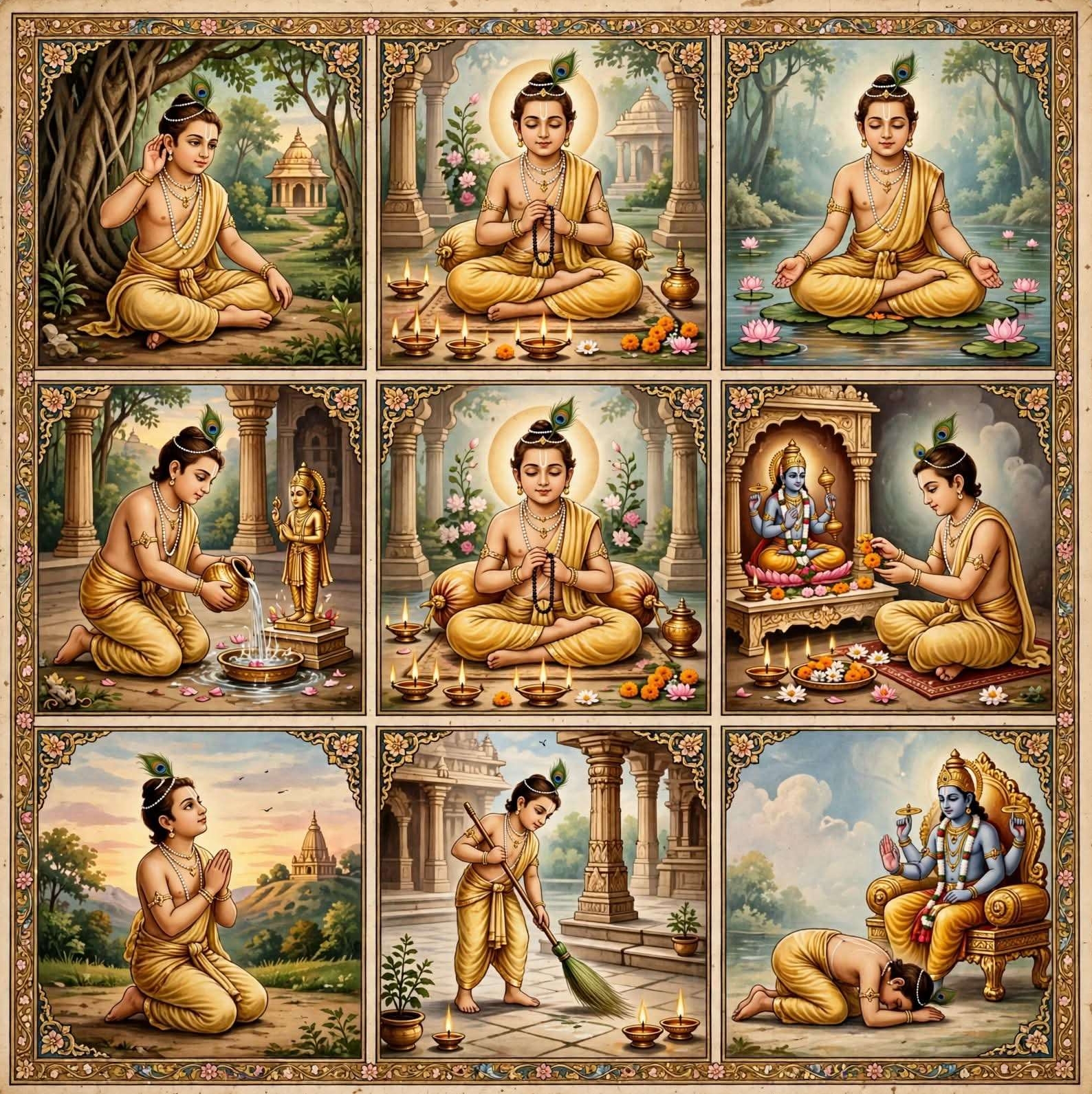
Śrīmad-Bhāgavatam 7.5.23-24
"Prahlāda Mahārāja said: Hearing and chanting about the transcendental holy name, form, qualities, paraphernalia and pastimes of Lord Viṣṇu, remembering them, serving the lotus feet of the Lord, offering the Lord respectful worship with sixteen types of paraphernalia, offering prayers to the Lord, becoming His servant, considering the Lord one’s best friend, and surrendering everything unto Him (in other words, serving Him with the body, mind and words) — these nine processes are accepted as pure devotional service. One who has dedicated his life to the service of Kṛṣṇa through these nine methods should be understood to be the most learned person, for he has acquired complete knowledge." Śrīmad-Bhāgavatam 7.5.23-24

Śrīmad-Bhāgavatam 7.5.27
"In due course of time, various types of diseases are manifest in those who are sinful. Similarly, in this world there are many deceptive friends in false garbs, but eventually, because of their false behavior, their actual enmity becomes manifest." https://vedy.online/en/sb7/5/27

Śrīmad-Bhāgavatam 7.5.30
"Prahlāda Mahārāja replied: Because of their uncontrolled senses, persons too addicted to materialistic life make progress toward hellish conditions and repeatedly chew that which has already been chewed. Their inclinations toward Kṛṣṇa are never aroused, either by the instructions of others, by their own efforts, or by a combination of both." https://vedy.online/en/sb7/5/30

Śrīmad-Bhāgavatam 7.5.31
"Persons who are strongly entrapped by the consciousness of enjoying material life, and who have therefore accepted as their leader or guru a similar blind man attached to external sense objects, cannot understand that the goal of life is to return home, back to Godhead, and engage in the service of Lord Viṣṇu. As blind men guided by another blind man miss the right path and fall into a ditch, materially attached men led by another materially attached man are bound by the ropes of fruitive labor, which are made of very strong cords, and they continue again and again in materialistic life, suffering the threefold miseries." https://vedy.online/en/sb7/5/31

Śrīmad-Bhāgavatam 7.5.32
"Unless they smear upon their bodies the dust of the lotus feet of a Vaiṣṇava completely freed from material contamination, persons very much inclined toward materialistic life cannot be attached to the lotus feet of the Lord, who is glorified for His uncommon activities. Only by becoming Kṛṣṇa conscious and taking shelter at the lotus feet of the Lord in this way can one be freed from material contamination." https://vedy.online/en/sb7/5/32

Śrīmad-Bhāgavatam 7.6.1
"Prahlāda Mahārāja said: One who is sufficiently intelligent should use the human form of body from the very beginning of life — in other words, from the tender age of childhood — to practice the activities of devotional service, giving up all other engagements. The human body is most rarely achieved, and although temporary like other bodies, it is meaningful because in human life one can perform devotional service. Even a slight amount of sincere devotional service can give one complete perfection." https://vedy.online/en/sb7/6/1