Verses
Verse topic
Verse source
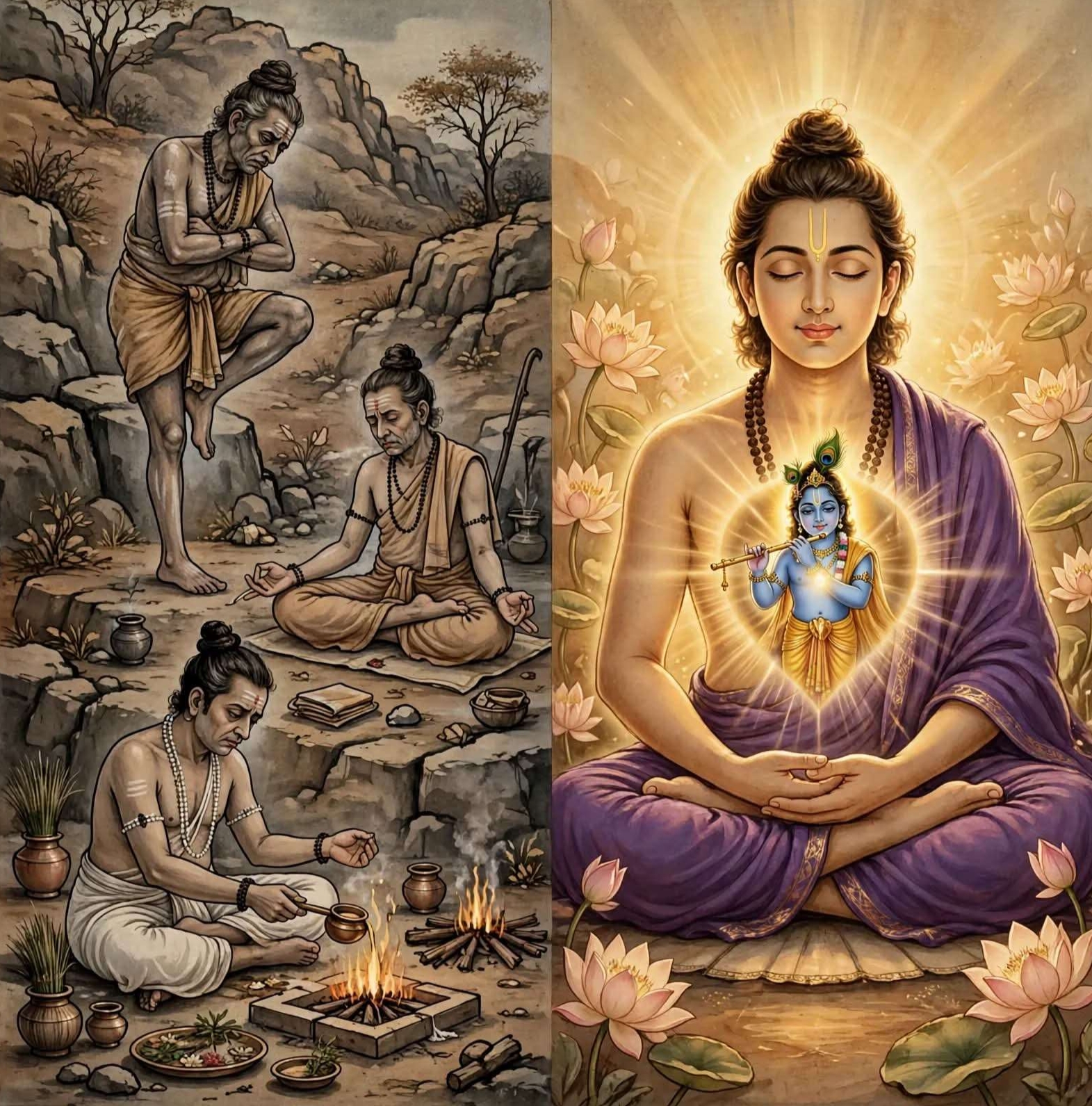
Śrīmad-Bhāgavatam 7.15.28
"Ritualistic ceremonies, regulative principles, austerities and the practice of yoga are all meant to control the senses and mind, but even after one is able to control the senses and mind, if he does not come to the point of meditation upon the Supreme Lord, all such activities are simply labor in frustration." https://vedy.online/en/sb7/15/28
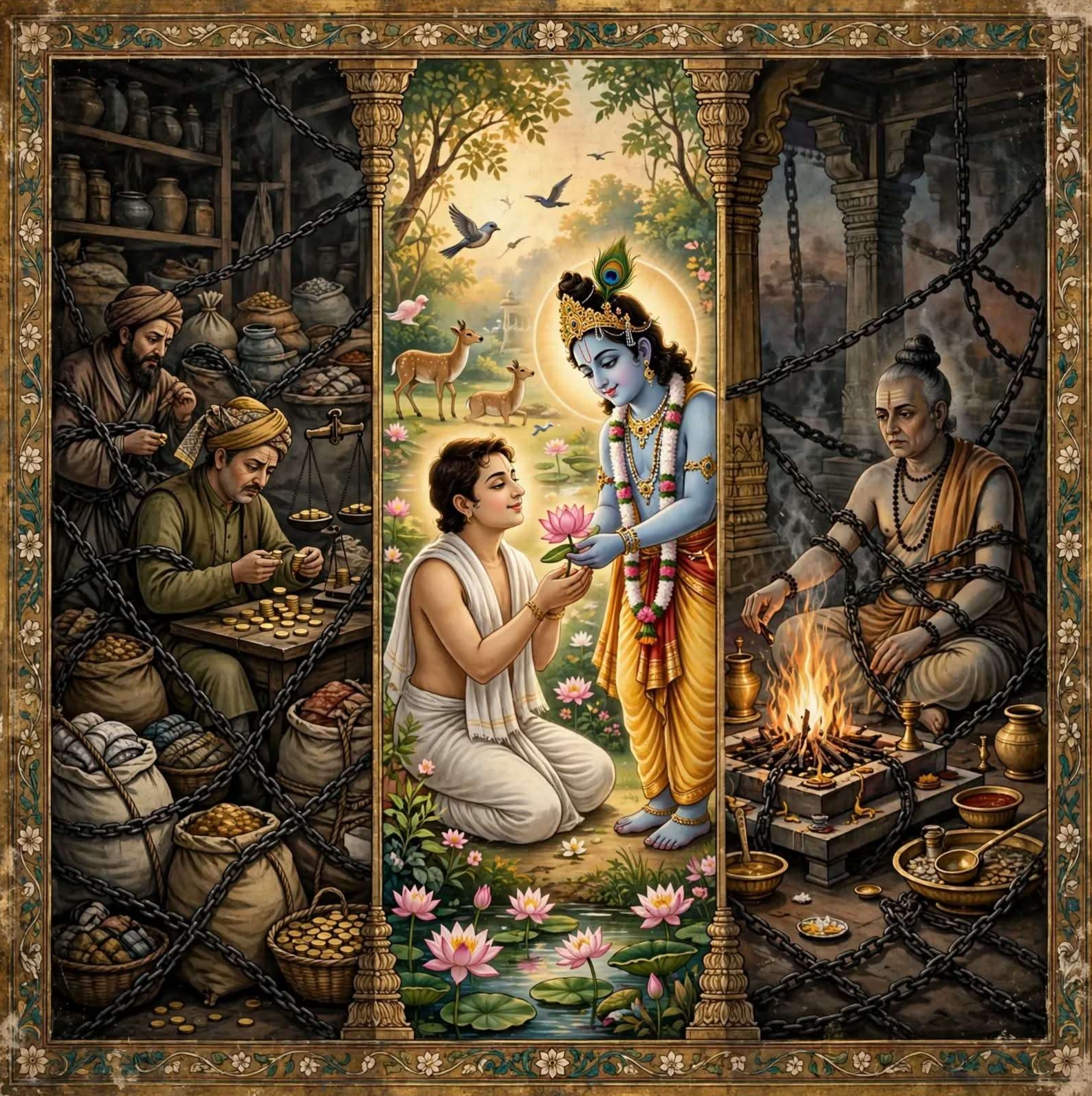
Śrīmad-Bhāgavatam 7.15.29
"As professional activities or business profits cannot help one in spiritual advancement but are a source of material entanglement, the Vedic ritualistic ceremonies cannot help anyone who is not a devotee of the Supreme Personality of Godhead." https://vedy.online/en/sb7/15/29

Śrīmad-Bhāgavatam 7.15.32-34
"While continuously staring at the tip of the nose, a learned yogī practices the breathing exercises through the technical means known as pūraka, kumbhaka and recaka — controlling inhalation and exhalation and then stopping them both. In this way the yogī restricts his mind from material attachments and gives up all mental desires. As soon as the mind, being defeated by lusty desires, drifts toward feelings of sense gratification, the yogī should immediately bring it back and arrest it within the core of his heart." "When the yogī regularly practices in this way, in a short time his heart becomes fixed and free from disturbance, like a fire without flames or smoke." Śrīmad-Bhāgavatam 7.15.32-33 & https://vedy.online/en/sb7/15/34

Śrīmad-Bhāgavatam 7.15.35
"When one’s consciousness is uncontaminated by material lusty desires, it becomes calm and peaceful in all activities, for one is situated in eternal blissful life. Once situated on that platform, one does not return to materialistic activities." https://vedy.online/en/sb7/15/35

Śrīmad-Bhāgavatam 7.15.40
"The human form of body is meant for understanding the self and the Supreme Self, the Supreme Personality of Godhead, both of whom are transcendentally situated. If both of them can be understood when one is purified by advanced knowledge, for what reason and for whom does a foolish, greedy person maintain the body for sense gratification?" https://vedy.online/en/sb7/15/40
Śrīmad-Bhāgavatam 7.15.41
"Transcendentalists who are advanced in knowledge compare the body, which is made by the order of the Supreme Personality of Godhead, to a chariot. The senses are like the horses; the mind, the master of the senses, is like the reins; the objects of the senses are the destinations; intelligence is the chariot driver; and consciousness, which spreads throughout the body, is the cause of bondage in this material world." https://vedy.online/en/sb7/15/41
Śrīmad-Bhāgavatam 7.15.43-44
"In the conditioned stage, one’s conceptions of life are sometimes polluted by passion and ignorance, which are exhibited by attachment, hostility, greed, lamentation, illusion, fear, madness, false prestige, insults, fault-finding, deception, envy, intolerance, passion, bewilderment, hunger and sleep. All of these are enemies. Sometimes one’s conceptions are also polluted by goodness." Śrīmad-Bhāgavatam 7.15.43-44

Śrīmad-Bhāgavatam 7.15.45
"As long as one has to accept a material body, with its different parts and paraphernalia, which are not fully under one’s control, one must have the lotus feet of his superiors, namely his spiritual master and the spiritual master’s predecessors. By their mercy, one can sharpen the sword of knowledge, and with the power of the Supreme Personality of Godhead’s mercy one must then conquer the enemies mentioned above. In this way, the devotee should be able to merge into his own transcendental bliss, and then he may give up his body and resume his spiritual identity." https://vedy.online/en/sb7/15/45

Śrīmad-Bhāgavatam 7.15.46
"Otherwise, if one does not take shelter of Acyuta and Baladeva, then the senses, acting as the horses, and the intelligence, acting as the driver, both being prone to material contamination, inattentively bring the body, which acts as the chariot, to the path of sense gratification. When one is thus attracted again by the rogues of viṣaya — eating, sleeping and mating — the horses and chariot driver are thrown into the blinding dark well of material existence, and one is again put into a dangerous and extremely fearful situation of repeated birth and death." https://vedy.online/en/sb7/15/46

Śrīmad-Bhāgavatam 7.15.47
"According to the Vedas, there are two kinds of activities — pravṛtti and nivṛtti. Pravṛtti activities involve raising oneself from a lower to a higher condition of materialistic life, whereas nivṛtti means the cessation of material desire. Through pravṛtti activities one suffers from material entanglement, but by nivṛtti activities one is purified and becomes fit to enjoy eternal, blissful life." https://vedy.online/en/sb7/15/47

Śrīmad-Bhāgavatam 7.15.54
"On his path of ascent, the progressive living entity enters the different worlds of fire, the sun, the day, the end of the day, the bright fortnight, the full moon, and the passing of the sun in the north, along with their presiding demigods. When he enters Brahmaloka, he enjoys life for many millions of years, and finally his material designation comes to an end. He then comes to a subtle designation, from which he attains the causal designation, witnessing all previous states. Upon the annihilation of this causal state, he attains his pure state, in which he identifies with the Supersoul. In this way the living entity becomes transcendental." https://vedy.online/en/sb7/15/54
Śrīmad-Bhāgavatam 7.15.57
"He who exists internally and externally, at the beginning and end of everything and of all living beings, as that which is enjoyable and as the enjoyer of everything, superior and inferior, is the Supreme Truth. He always exists as knowledge and the object of knowledge, as expression and the object of understanding, as darkness and as light. Thus He, the Supreme Lord, is everything." https://vedy.online/en/sb7/15/57