Verses
Verse topic
Verse source

Śrīmad-Bhāgavatam 10.2.27
"The body [the total body and the individual body are of the same composition] may figuratively be called “the original tree.” From this tree, which fully depends on the ground of material nature, come two kinds of fruit — the enjoyment of happiness and the suffering of distress. The cause of the tree, forming its three roots, is association with the three modes of material nature — goodness, passion and ignorance. The fruits of bodily happiness have four tastes — religiosity, economic development, sense gratification and liberation — which are experienced through five senses for acquiring knowledge in the midst of six circumstances: lamentation, illusion, old age, death, hunger and thirst. The seven layers of bark covering the tree are skin, blood, muscle, fat, bone, marrow and semen, and the eight branches of the tree are the five gross and three subtle elements — earth, water, fire, air, ether, mind, intelligence and false ego. The tree of the body has nine hollows — the eyes, the ears, the nostrils, the mouth, the rectum and the genitals — and ten leaves, the ten airs passing through the body. In this tree of the body there are two birds: one is the individual soul, and the other is the Supersoul." https://vedy.online/en/sb10/2/27

Śrīmad-Bhāgavatam 10.2.28
"The efficient cause of this material world, manifested with its many varieties as the original tree, is You, O Lord. You are also the maintainer of this material world, and after annihilation You are the one in whom everything is conserved. Those who are covered by Your external energy cannot see You behind this manifestation, but theirs is not the vision of learned devotees." https://vedy.online/en/sb10/2/28
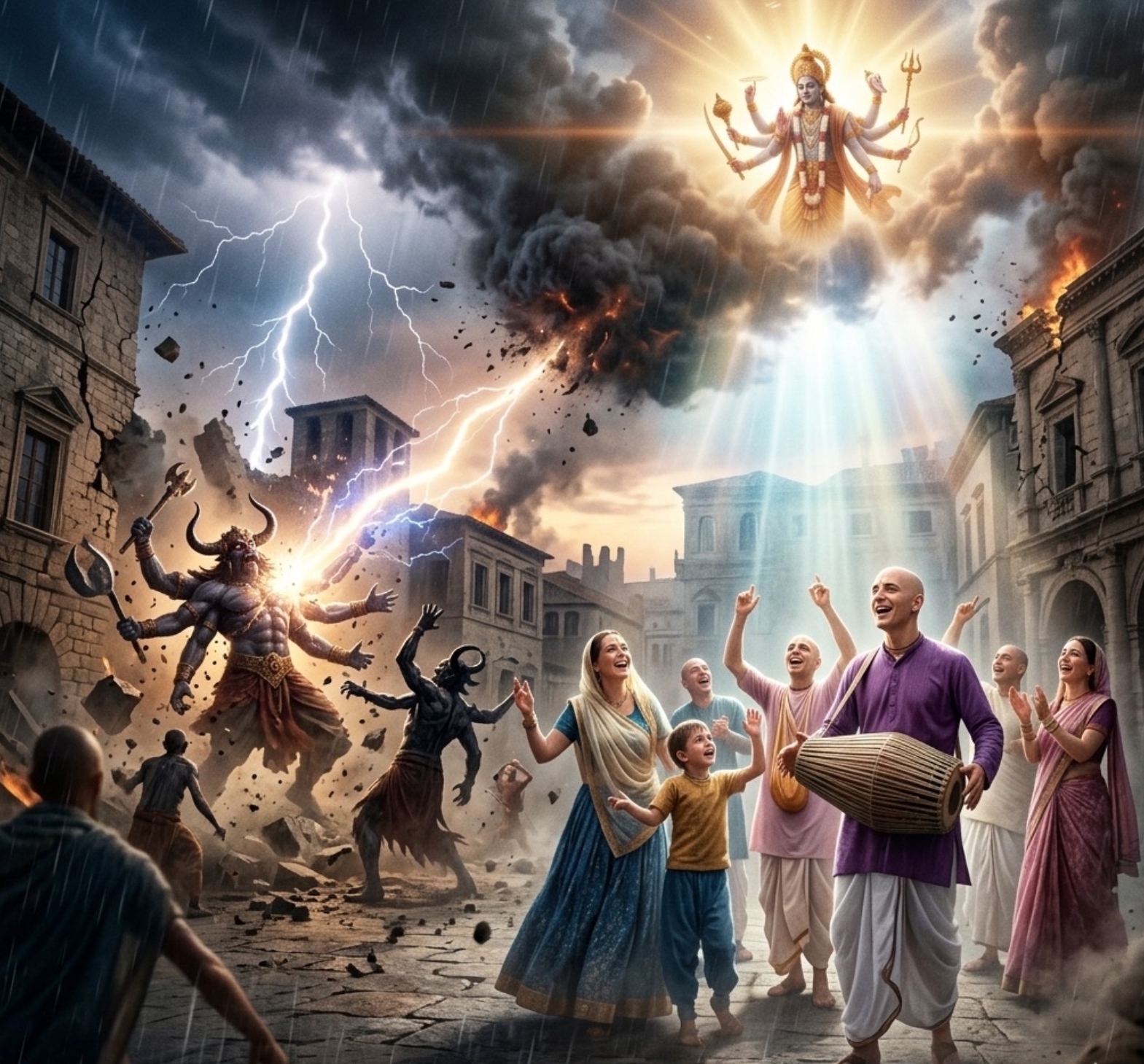
Śrīmad-Bhāgavatam 10.2.29
"O Lord, You are always in full knowledge, and to bring all good fortune to all living entities, You appear in different incarnations, all of them transcendental to the material creation. When You appear in these incarnations, You are pleasing to the pious and religious devotees, but for nondevotees You are the annihilator." https://vedy.online/en/sb10/2/29

Śrīmad-Bhāgavatam 10.2.30
"O lotus-eyed Lord, by concentrating one’s meditation on Your lotus feet, which are the reservoir of all existence, and by accepting those lotus feet as the boat by which to cross the ocean of nescience, one follows in the footsteps of mahājanas [great saints, sages and devotees]. By this simple process, one can cross the ocean of nescience as easily as one steps over the hoofprint of a calf." https://vedy.online/en/sb10/2/30

Śrīmad-Bhāgavatam 10.2.36
"O Lord, Your transcendental name and form are not ascertained by those who merely speculate on the path of imagination. Your name, form and attributes can be ascertained only through devotional service." https://vedy.online/en/sb10/2/36

Śrīmad-Bhāgavatam 10.2.37
"Even while engaged in various activities, devotees whose minds are completely absorbed at Your lotus feet, and who constantly hear, chant, contemplate and cause others to remember Your transcendental names and forms, are always on the transcendental platform, and thus they can understand the Supreme Personality of Godhead." https://vedy.online/en/sb10/2/37

Śrīmad-Bhāgavatam 10.2.39
"O Supreme Lord, You are not an ordinary living entity appearing in this material world as a result of fruitive activities. Therefore Your appearance or birth in this world has no other cause than Your pleasure potency. Similarly, the living entities, who are part of You, have no cause for miseries like birth, death and old age, except when these living entities are conducted by Your external energy." https://vedy.online/en/sb10/2/39

Śrīmad-Bhāgavatam 10.3.18
"One who considers his visible body, which is a product of the three modes of nature, to be independent of the soul is unaware of the basis of existence, and therefore he is a rascal. Those who are learned have rejected this conclusion because one can understand through full discussion that with no basis in soul, the visible body and senses would be insubstantial. Nonetheless, although his conclusion has been rejected, a foolish person considers it a reality." https://vedy.online/en/sb10/3/18

Śrīmad-Bhāgavatam 10.3.26
"O inaugurator of the material energy, this wonderful creation works under the control of powerful time, which is divided into seconds, minutes, hours and years. This element of time, which extends for many millions of years, is but another form of Lord Viṣṇu. For Your pastimes, You act as the controller of time, but You are the reservoir of all good fortune. Let me offer my full surrender unto Your Lordship." https://vedy.online/en/sb10/3/26

Śrīmad-Bhāgavatam 10.4.19
"In this world, we can see that pots, dolls and other products of the earth appear, break and then disappear, mixing with the earth. Similarly, the bodies of all conditioned living entities are annihilated, but the living entities, like the earth itself, are unchanging and never annihilated [na hanyate hanyamāne śarīre]." https://vedy.online/en/sb10/4/19

Śrīmad-Bhāgavatam 10.4.20
"One who does not understand the constitutional position of the body and the soul [ātmā] becomes too attached to the bodily concept of life. Consequently, because of attachment to the body and its by-products, he feels affected by union with and separation from his family, society and nation. As long as this continues, one continues his material life. [Otherwise, one is liberated.]" https://vedy.online/en/sb10/4/20

Śrīmad-Bhāgavatam 10.4.22
"In the bodily conception of life, one remains in darkness, without self-realization, thinking, “I am being killed” or “I have killed my enemies.” As long as a foolish person thus considers the self to be the killer or the killed, he continues to be responsible for material obligations, and consequently he suffers the reactions of happiness and distress." https://vedy.online/en/sb10/4/22